
- stop at the edge of the street, and look both ways and over your shoulder before crossing
- signal your intention to cross, and wait until vehicles have fully stopped
- make eye contact with drivers before you cross
- cross quickly, and avoid using your phone while crossing
- walk, do not run, across the street
- get off your bike and walk it across the street
Traffic and Road Safety
The City of St. Thomas is committed to safe, convenient travel for drivers, cyclists and pedestrians.
- yield to pedestrians in marked crosswalks and crossovers
- stop at yield lines and stop bars, making eye contact with pedestrians before they cross
- watch for pedestrians who may enter a crosswalk and crossovers unexpectedly
- do not pass a vehicle stopped at a crosswalk and crossovers. This is against the law
- wait until pedestrians have fully crossed at a crossover before continuing. Failing to do so is against the law
Sharing the road with cyclists
Cyclists are vehicles under the Highway Traffic Act and must follow the same rules as drivers.
If you are driving:
- give at least 1 metre of space when passing a bike
- check for cyclists before opening your car door
- look both ways for cyclists and pedestrians before turning
If you are cycling:
- obey all traffic laws, signs and signals
- signal your turns
- ride in cycling facilities when provided or 1 metre from the curb, and in a straight line
- wear a helmet and bright clothing
- equip your bike with a horn or bell, a front white light, and a rear red light or reflector
Unlike a typical intersection, drivers must stop and wait until pedestrians have completely crossed the road at a pedestrian crossover.
If you are a pedestrian:
- push the button for flashing lights, if available
- signal your intention to cross
- wait for traffic to stop, and make eye contact with the driver
- cross once it is safe
If you are a driver:
- stop behind the yield line
- make eye contact with the pedestrian
- wait until they completely cross before continuing
- do not pass another stopped vehicle
Drivers who fail to stop for a pedestrian crossover can be fined up to $1,000 and receive 4 demerit points.
Crosswalks vs. pedestrian crossovers
| Crosswalks | Pedestrian crossovers |
|---|---|
| May have ladder-style markings | Always have ladder-style markings |
| Found at intersections, stop signs or school crossings | Always have "Stop for Pedestrians" signage |
| Drivers can proceed once a pedestrian has cleared their lane and path of travel | Drivers must wait until the pedestrian fully crosses |
The City of St. Thomas provides crossing guards at various locations across the city to help pedestrians safely cross the road during busy school travel times.
Crossing guard locations and hours (2026-2027 school year):
- Forest Avenue and Park Avenue
- 8:35 to 9:15 a.m.
- 3:20 to 4 p.m.
- South Edgeware Road and Dalewood Road
- 8:25 to 9:10 a.m.
- 3:10 to 3:50 p.m.
- Fairview Avenue and Forest Avenue
- 8:20 to 9 a.m.
- 3:20 to 4 p.m.
- Raven Avenue and Peach Tree Boulevard
- 8:30 to 9:10 a.m.
- 3:10 to 3:50 p.m.
- Balaclava Street and Edward Street
- 8:25 to 9:10 a.m.
- 3:15 to 3:55 p.m.
When a school crossing guard displays their stop sign, drivers and cyclists are required by law to stop and remain stopped until all pedestrians and the crossing guard have completely cleared the roadway and it is safe to proceed.
How parents can help
- Review and practice a safe route to and from school with your child
- Know your school crossing guard’s location and operating schedule
- Lead by example by following all traffic signs, signals, and crossing rules
- Encourage your child to stay alert and avoid using headphones or other distractions near roadways
- Remind your child to dismount and walk their bicycle, scooter, skateboard, or other wheeled device when crossing the street
How motorists can help
- Stop before the crosswalk when a crossing guard displays the stop sign
- Remain stopped until all pedestrians have crossed safely and the crossing guard has returned to the curb
- Be attentive and respectful around school crossings
- Obey posted speed limits and drive with extra caution in Community Safety Zones
- Drivers who fail to comply with a crossing guard’s directions may be subject to fines
A roundabout is a circular intersection where 2 or more roads meet. Traffic moves counter-clockwise around a centre island. All entering vehicles must yield to traffic already in the roundabout.
Roundabouts are safer, lower speeds, handle traffic more efficiently, and reduce delays, idling and maintenance costs compared to traditional intersections.
Learn more about roundabouts and signage
Driving through a roundabout:
- choose your lane before you enter, the same way you would at a regular intersection
- slow down and yield to pedestrians
- yield to traffic already in the roundabout
- do not enter the roundabout next to buses or larges trucks – they will often require both lanes to turn
- stay in your lane, and signal right as you exit
Walking near a roundabout: Use designated crossings, sidewalks or multi-use paths. Never cross through the centre. Cross one direction of traffic at a time, pausing on pedestrian islands in between, and make eye contact with drivers before you cross.
Cycling through a roundabout: Ride through like a vehicle, staying in the centre of your lane, or walk your bike across using the crosswalks.
What Is Traffic Calming?
Traffic calming uses physical and non-physical measures to reduce vehicle speeds and improve road safety. Measures may include line painting, flexible bollards, speed radar signs, speed cushions, raised crosswalks and curb extensions.
These measures can help make neighbourhood streets safer and more comfortable for pedestrians, cyclists and drivers.
Traffic Calming Process
The City follows a consistent process when reviewing requests for traffic calming. This helps ensure requests are assessed fairly and that measures are appropriate for each location.
- Traffic calming request
- Data collection
- Review against minimum criteria
- Implement Level 1 non-physical measures
- Monitor and evaluate
If traffic speeds remain above established thresholds after one year of Level 1 measures, the City may proceed to Level 2 physical measures.
The Level 2 process includes community engagement, developing a traffic calming plan and obtaining Council approval before measures are implemented.
To make a traffic calming request, contact Customer Service.
The Pace Car Program encourages residents to help reduce vehicle speeds and promote safer streets, particularly in residential and pedestrian-focused areas.
Participants commit to:
- driving the posted speed limit
- being a positive example for other drivers
- displaying a Pace Car emblem on their vehicle
When more residents participate, Pace Cars can help build a culture of safe and responsible driving throughout the community.
How to Participate
Interested in joining the Pace Car Program? Contact Customer Service for more information.
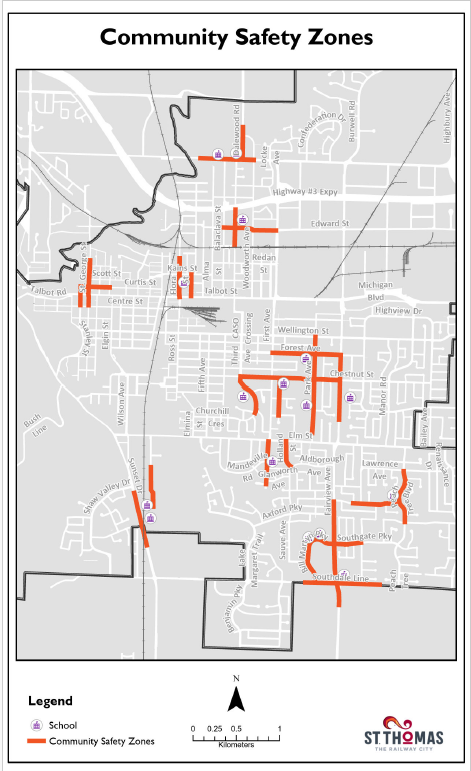
The City of St. Thomas is committed to keeping roads safe for everyone. Community Safety Zones are designated areas where public safety is a special concern due to higher levels of pedestrian activity and nearby community facilities such as schools, parks, hospitals and recreation centres.
Community Safety Zones are established through City by-law under provincial legislation. They are intended to encourage safer driving, increase awareness and help reduce the risk and severity of collisions.
What Is a Community Safety Zone?
A Community Safety Zone is a clearly signed section of roadway designated under the Highway Traffic Act where drivers are encouraged to use extra caution.
These zones are typically located near areas where people are more likely to walk, cycle or cross the road, including schools, playgrounds, parks and other community facilities.
Community Safety Zones are in effect 24 hours a day, seven days a week, year-round.
Why Do Community Safety Zones Matter?
Lower vehicle speeds can help improve road safety, particularly in areas with higher levels of pedestrian and community activity.
Community Safety Zones are intended to:
- improve safety in areas where there is a higher level of pedestrian activity
- reduce the risk and severity of collisions
- encourage safe and responsible driving
- community Safety Zone Locations
Speed Limits and Enforcement
Drivers must obey the posted speed limit within all Community Safety Zones.
Under provincial legislation, speeding offences committed within a Community Safety Zone may carry higher penalties than similar offences committed outside of a zone.
Sign up to our News and Notices
Stay up to date on the City's activities, events, programs and operations by subscribing to our news and notices.