10-Year Infrastructure Capital Plan

The 10 year capital plan for infrastructure projects within the roadway is available as a map and as a table. The City operates and maintains approximately $1.2 billion worth of assets which require continual rehabilitation and replacement. This clear long term plan will ensure the efficient use of available budgets and maximize asset lifecycles. All streets will be reconstructed using a Complete Streets approach to create attractive and livable streets.

The plan was developed using in-house staff expertise, condition assessment data, risk assessments, and various studies. Projects are prioritized based on a number of factors including risk, most effective timing of rehabilitation to maximize lifecycle, areas with combined sewers, pipe upsizing required for upstream development, water quality improvements, etc. Selecting the projects is complicated by the fact that there are multiple assets (i.e. watermain, sewers, road, streetlights, etc.) within the same roadway that all have varying life expectancies and rehabilitation or replacement needs. For more information on how projects are selected check out the Roads Construction FAQ below.

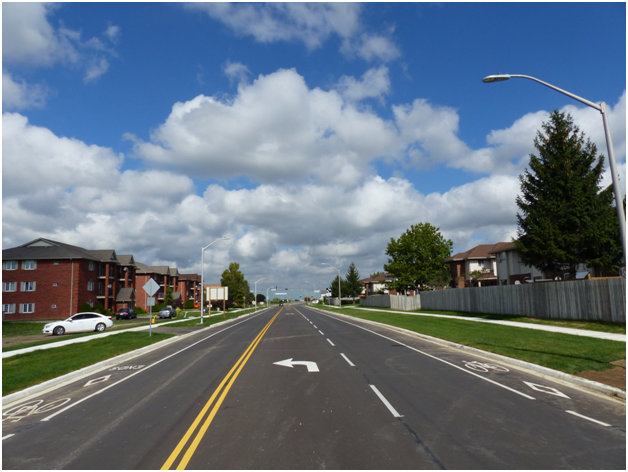
view of Manor Road looking north towards Talbot Street

The map includes the pavement condition map and the watermain and sanitary sewer risk maps. The risk is based on the likelihood of failure (i.e. age, material, etc.) and the consequence of failure (i.e. larger pipes impact more users, break on major road disrupts more traffic, etc.).


When looking at a street people can only see what is on the surface including the road, sidewalk, and curb and gutter.  However, if we look further, there is a lot of important but often unnoticed underground infrastructure including sewers, watermain, gas, electricity, etc.

Diagram of Street Infrastructure

Choosing when to reconstruct a street involves analyzing each piece of infrastructure within a roadway and determining the most effective year to complete the work.  In an ideal situation all of the infrastructure would require replacement at the same time, but in reality the lifecycle of each piece varies.  Each piece of infrastructure is inspected on a regular basis and given an overall rating.  Streets are then prioritized on criteria related to each of the individual pieces of infrastructure including condition, target level of service and risk.

It can be challenging to prioritize which street to reconstruct.  In addition to the items mentioned there are other factors that might prioritize one street over another including if it has combined sewers (where storm flows enter the sanitary sewer) or increased capacity is required for upstream development.

An example of the decision that needs to be made is:  do you reconstruct the street where the road is in good condition but the sewers are in very poor condition or the street where the road is in fair condition and the watermain is in poor condition?

This decision is similar to that of a homeowner who has to weigh the pros and cons of various projects and prioritize what work can be completed within their budget.  For example, do you replace your leaky roof or your old furnace which will break at any moment?

The city has 437 lane kilometers of road (1 kilometer of 4 lane road = 4 lane kilometers) with an estimated replacement value of $301 million.  For a fully sustainable road network we should be spending between $6 million and $9 million per year on our roads.  For more information see the road asset report card.

The City has a long term asset management plan that prioritizes which street to reconstruct based on a large set of criteria.  This means that sometimes a road is reconstructed where the surface appears to be in better condition than another street for a number of reasons:

  • a preventative rehabilitation provides best value
  • the underground infrastructure is in worse condition
  • there is a higher environmental or social risk of infrastructure failing
  • the work is coordinated with other replacement work
  • the other street in question is scheduled for a future reconstruction
  • the upstream area requires larger sewers/water for a new development or redevelopment.

Different types of streets have different levels of service.  For example, arterial roads like Talbot Street are given higher priority as they have more traffic and higher pedestrian volumes compared to local roads.  These roads require more attention as the asphalt surface wears quicker and vehicles travel at higher rates of speed.

For each project the City evaluates and determines the most cost effective method to complete the work.  If only one or two pieces of underground infrastructure are in poor condition but the others are in good condition and the surface is in good condition then trenchless technologies are evaluated.  Trenchless construction means that the road is not ripped up to complete the work. For sewers, the work can be completed from the manholes.  For watermains, only a few small excavations are required.  Trenchless options can provide significant cost savings compared to full reconstruction and minimize the disruption to the street.

If the underground infrastructure is in good condition and only the asphalt is in poor condition then we do a road rehabilitation where typically only the asphalt is removed and replaced.  When choosing which rehabilitation technique to use we try to match up the future reconstruction requirements.  Removing and replacing only the top half of the asphalt can add 10-20 years to the life of the road and replacing all of the asphalt can add 30-40 years to the life.  If the underground infrastructure needs to be replaced in 20 years then we wouldn't want to spend the extra money for the 30-40 year fix right now.

              Road Rehabilitation                                         Road Reconstruction

Road Rehab pictures

The City reviews each individual project for options to get them completed as quickly as possible. Construction contracts have deadlines that must be met and financial penalties if they are not met.  Schedules are set based on the concept of forcing the contractor to work as quickly as possible but not too fast to drive up the cost.

Overnight construction increases costs, increases safety risks, and results in noise concerns both at the construction site and along trucking routes.  Contractors already work long days and for most projects overnight work is not appropriate.  However, overnight work can be an option for high disruption, short term construction, for example when repaving a major intersection.

So work can be done at night but adds increased costs.  Higher cost projects either lead to less projects being completed overall or higher taxes.  A balance needs to be found between mitigating social impacts and affordably replacing our infrastructure.

Contact Us

City of St. Thomas
545 Talbot Street, PO Box 520,
St. Thomas, Ontario N5P 3V7
Canada

Phone: (519) 631-1680
customerservice@stthomas.ca 

Sign up to our News and Notices

Stay up to date on the City's activities, events, programs and operations by subscribing to our news and notices.